
C Purlin Roll Forming Machine
Factory-direct C purlin roll forming machines from our Xiamen manufacturing base — fixed-size or adjustable C lines with punching and cutting configured to your section drawing, steel thickness and hole pattern.
Price range: C/Z purlin roll forming machines
US$39,000–62,000 (standard) · US$72,000–143,000 (premium), FOB China
Standard covers the first two configuration levels (single-profile and multi-profile / quick-change); premium covers fully automatic lines.
Final price depends on profile, thickness, speed, punching and automation. Excludes freight, import duties and installation. Send your profile drawing for a quotation within 24 hours. North American configurations (480V/60Hz, UL and local requirements) are quoted separately.
Large complete lines (e.g. truck chassis beam lines or full cable tray lines) are quoted per project, typically above US$150,000.
Manufactured in our Xiamen factory · 35+ years of roll forming experience.
Profiles this machine can make
Illustrative sections. Your machine is configured to your own profile drawing.
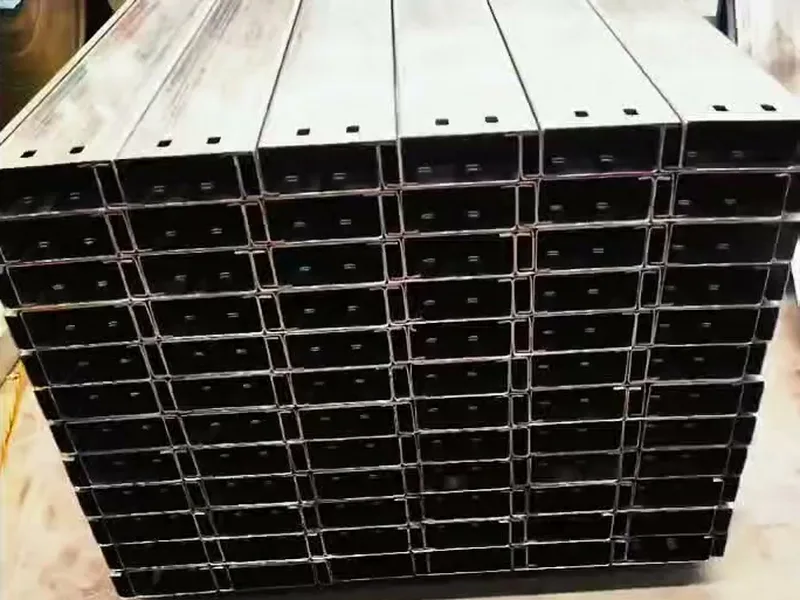 Factory photo
C purlin
- Size
- Web 75–300 mm, flange 30–80 mm, lip 10–20 mm, 1.0–3.0 mm (HC-300L reference)
- Use
- Roof and wall purlins of steel buildings
- Changeover
- Button-operated automatic size change on the HC-300L; a fixed line suits one repeat size.
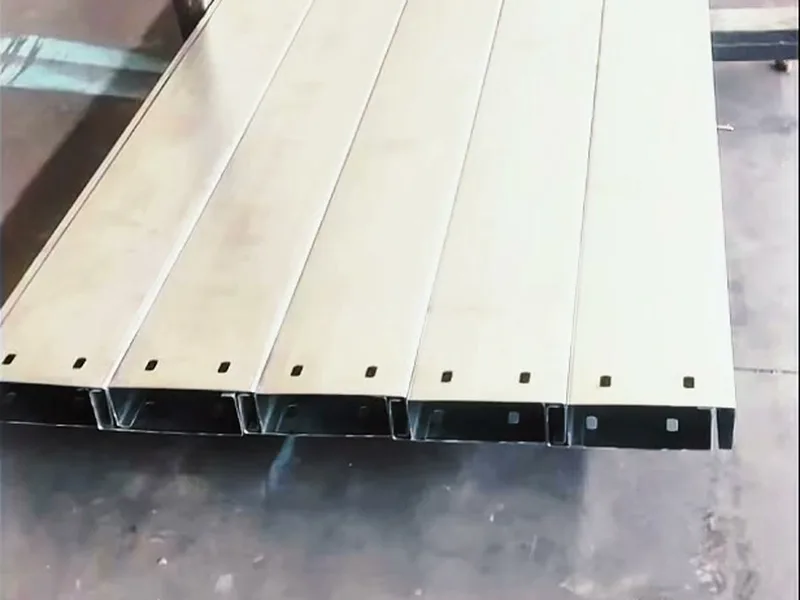 Factory photo
Pre-punched C purlin (bolt holes)
- Size
- Hole layout to your drawing
- Use
- Purlins bolted to cleats on site, no drilling
- Changeover
- Pre-punching or post-punching, hydraulic or servo, set to your hole layout.
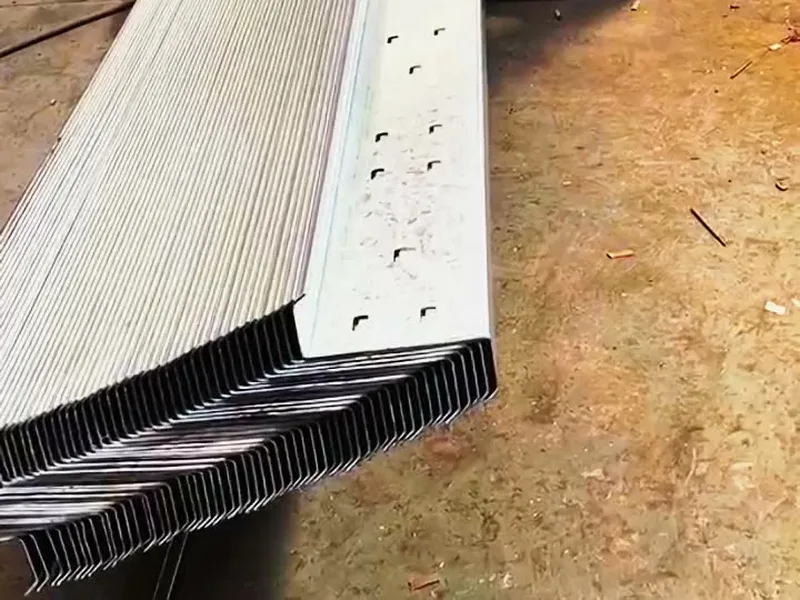 Factory photo
Z purlin
- Size
- Z web 120–300 mm, 1.0–3.0 mm (HCZ-S20 C/Z line)
- Use
- Lapped continuous purlins over long roof spans
- Changeover
- A C-only machine cannot form Z: choose a C/Z line. See machine →
Get a quote for this machine
Send your profile drawing or a photo of the profile. We reply within 24 hours with a configuration and price.
Commercial terms
- Lead time
- standard machines 30–60 days; automatic and heavy-duty lines 60–120 days (confirmed in the quotation).
- Warranty
- 12 months on the machine, lifetime technical support by video and remote guidance; wear parts excluded.
- Payment
- 30% deposit; 70% before shipment, after you approve the trial-run video.
- Shipping
- FOB Xiamen, China.
Compare fixed and adjustable C purlin machines
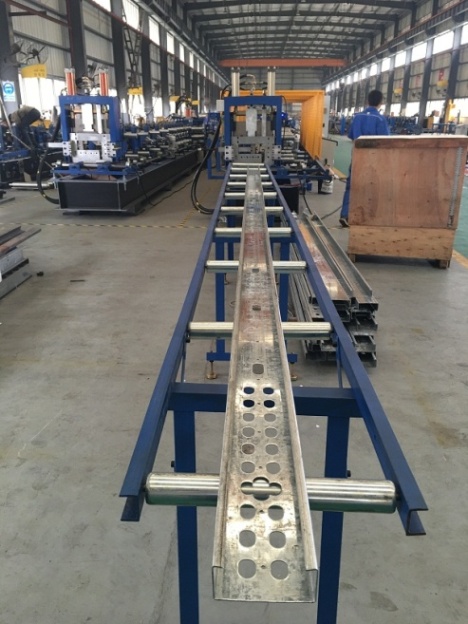
For several approved C sizes, review an adjustable line. For one repeatable section, compare a fixed-size build. The two photographs below show the two configurations.
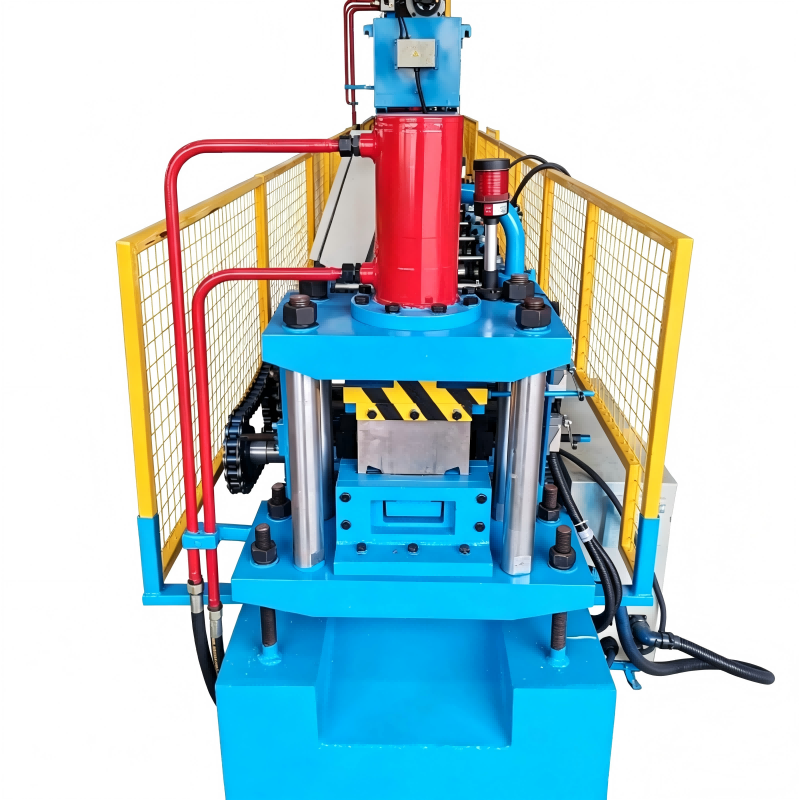
When does a C-only purlin line make sense?
Direct answer: A dedicated C-section line is worth comparing when your order book uses only C profiles and the approved drawings, material and punching can be covered by its actual tools. A fixed-size C machine suits a narrow, repeatable profile requirement; an adjustable C machine may suit several approved C sizes. If Z purlins are also required, compare a documented C/Z changeover line instead of assuming a C-only machine can form both shapes.
“C purlin”, “C section” and “Cee purlin” describe a cross-section, not a universal material thickness or load rating. The building engineer decides whether a finished member suits the structure. The machine proposal must be checked against the exact drawing and trial material.
Which C channel roll forming machine fits your product?
The name C channel does not identify a complete machine specification. For a roof or wall purlin, use the C-only selection and trial checks on this page. For another use, compare the appropriate profile family below before requesting tooling. Confirm whether rolls, punches and cutters are shared or profile-specific.
| Finished product | Relevant equipment review | Drawing details to distinguish |
|---|---|---|
| Drywall C-stud with U-track | Stud and track forming | Check both mating sections, lips, service holes and the stud-to-track fit. |
| Solar mounting rail or slotted strut | Solar mounting profile selection | Check returns, slots, mounting interfaces and the specified rail section; a purlin trial does not prove strut tooling. |
| Other custom C-section | Custom steel-section line review | Submit the end-use drawing, material, bend radii, tolerances and hole schedule; require a written tool and trial scope. |
How does a C purlin roll forming machine work?
A C purlin line feeds steel strip through progressive rolls to form the approved C section, then delivers pieces at the specified lengths. Coil handling, leveling, punching, cutting and collection must be identified in the actual line proposal. Their sequence and automation depend on the build; pre-punching, pre-cutting and automatic stacking are not universal features.
- Load and guide the coil. Confirm the proposed decoiler, coil limits and guiding arrangement for the order material. Identify leveling if included.
- Locate the holes. If the drawing requires holes or slots, specify whether they are made before or after forming and how positions are measured. An unpunched trial cannot prove a punched part.
- Form the C section. The rolls and guides must match the approved web, flanges, lips, bend radii, steel grade and thickness. Confirm each required size combination in the quotation.
- Cut and support the part. Confirm pre-cut or post-cut operation, the length-control method and support for the shortest and longest pieces. These choices must agree with the proposed hole pattern and tooling.
- Collect and identify samples. State whether handling is manual or automated. Keep first-off and later pieces labeled with the drawing revision, coil batch and settings.
- Measure accepted output. Count pieces meeting the agreed dimensions during a timed batch that includes the specified punching, cutting and size changes. Record stops and rejected parts separately from roll-motion speed.
Ask for a station-by-station layout and a video of the offered sequence, followed by measured samples. Use the punching-sequence guide and the three-size C-purlin trial to define the checks. Acceptance is agreed on your own trial parts.
Compare the three purchase routes
| Line scope | Suitable buying question | What to verify |
|---|---|---|
| Fixed C section | Will one drawing account for most production? | Named section, steel and thickness, punching, cut length and repeat samples. The photographed C75 unit is one light-gauge example only. |
| Adjustable C section | Which C sizes change during a normal shift? | Quoted size range, rolls and guides, punching/cutter adjustment, operator steps, setup scrap and first acceptable part for each approved size. See the M Series and L Series scopes; neither model-family name proves your drawing is covered. |
| C and Z on one line | Must the schedule serve both section shapes? | Included C and Z tooling, adjustment sequence in both directions, accepted samples and measured downtime. See the automatic C/Z guide. |
What does a published adjustable C-line example prove?
Our Xiamen production base lists an HC-300L C-only line. Its public product sheet gives a 75–300 mm web, 30–80 mm flange, 10–20 mm lip and 1.0–3.0 mm material-thickness reference. It quotes 30 m/min for forming without punching and cutting. Those are supplier-listed reference conditions for that named model, not a promise of finished, punched parts per minute or of current availability. A quotation must confirm the exact offered build, steel grade, compatible dimensions and included tooling together.
If your C-section drawing includes holes or slots, agree the punching stage, measurement datum and trial samples with our factory team. Use our pre-punching versus post-punching guide to check whether the proposed sequence suits your approved hole layout.
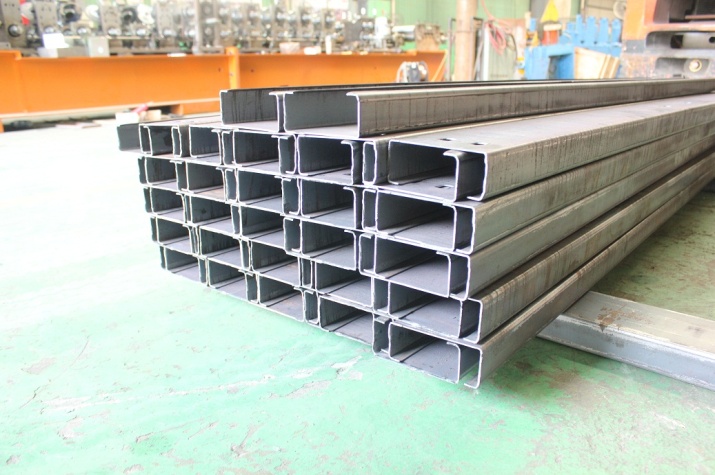
For the buyer’s actual C section, record web, both flanges, lips, hole position and finished length on identified trial parts. Confirm the material and operating cycle used for any speed claim. This separates a catalogue range from a line that has been accepted against your drawing.
HC-300L C-line configuration reference
Our Xiamen production base's published component list provides a concrete starting point for comparing an adjustable C-only line. The table below refers to that named HC-300L listing, checked on 3 October 2026. Confirm the current offered build and your material with the factory before using it as an order specification.
| Component | Published supplier reference | Check for your order |
|---|---|---|
| Coil pay-off | Manual decoiler; listed coil mass capacity 5.0 t | Confirm coil bore, outer diameter, strip width, loading method and the offered decoiler rating together. |
| Forming system | 17 forming groups; listed motor power 18.5 kW | Identify the offered rolls and drive configuration for the drawing and steel grade. Compare accepted output, not motor power alone. |
| Size adjustment | Button-operated automatic size change | Demonstrate each quoted section size, remaining operator adjustments and the first acceptable part after a change. |
| Punching | Post-punching on the formed section; PLC controls quantity and horizontal position | Confirm tool access, datum, hole shape and measured location against the approved hole schedule. |
| Cutting and outfeed | Hydraulic cutting; listed support frame length 6 m | Check the proposed cutter and support for the actual shortest and longest finished parts. |
| Operating cycle | The listing states that forming stops during punching and cutting | Measure a complete timed batch with the agreed holes, lengths and changes. The published forming-only speed excludes these operations. |
Read our Xiamen production base's HC-300L technical parameters and component list alongside the written proposal. For C and Z sections from one line, see the automatic C/Z machine.
Send the C drawing before comparing machine prices
- Profile drawingWeb, flange and lip dimensions, tolerances, section revision and any mating connection.
- Steel and coilGrade, coating, thickness range, coil width and available supply.
- PunchingHole and slot locations, datum, unpunched zones and part orientation.
- Production planFinished lengths, batch quantities, changes per shift and target accepted output.
- DestinationElectrical supply and any installation, safety or documentation requirements.
For a comparable quotation, send the same requirements to each proposed build. Halcyon works directly with the factory team on configuration and trial planning; the written project documents identify the actual manufacturing company, model, scope and evidence. For the cost items to compare across different machine offers, use our roll forming machine price and quotation guide. This page does not promise a universal speed, thickness range, accuracy, price or delivery time.
How much does a C purlin roll forming machine cost?
Direct answer: We quote every C purlin roll forming machine by configuration, not from a fixed price list. The price depends on the profile drawing, material thickness, punching and cutting, the level of automation and the delivery terms. Send your drawing and we reply with a written quotation for that exact configuration.
| Configuration level | What changes | Usually chosen for |
|---|---|---|
| Basic fixed-size C or Z line | One section size per tooling setup; sizes changed manually by adjusting or replacing tooling. | Steady orders for one or a few standard sizes |
| Quick-change C/Z line | C and Z sections from one line, with faster shape and size changeover. | Mixed C and Z orders with regular size changes |
| Fully automatic stepless C/Z line | Section width and height set from the control system within the line's size range, with automatic punching and cut-off. | High-mix production and frequent size changes |
Price rises from the first level to the third as tooling, servo control and automation are added.
What affects the price
- C section size range (web, flange and lip) and number of sizes
- Steel thickness and yield strength
- Punching layout: pre-punching or post-punching, hydraulic or servo
- Cut-off method: stop-to-cut or flying cut
- Manual, quick-change or fully automatic size change
- Control system and main component brands (PLC, servo, hydraulics)
- Decoiler, outfeed table and automatic stacking
- Delivery terms (FOB or CIF), packing and spare parts
Roll forming machines from Halcyon's Xiamen factory have been used on 150+ construction projects (2022–2026) in China and abroad, including an airport in Iraq, a national stadium in Senegal, resort buildings in the Maldives and a coal preparation plant in Mongolia. See the reference projects.
How can I compare a C purlin machine price?
Direct answer: Compare written offers for the same C-section drawings, steel, thickness, hole layout and accepted output. Separate the base machine from optional modules and destination costs. Compare prices on the same configuration.
| Compare separately | Ask each offer to state |
|---|---|
| Machine and tooling | Named build, drawing revisions, fixed or adjustable C range, supplied tools and size-change steps |
| Included line modules | Decoiler, guiding or leveling, punching, cut-off, outfeed and stacking: included, optional or excluded |
| Production evidence | Accepted parts for the agreed batch mix, including punching, cutting and size changes; record the trial conditions |
| Commercial basis | Currency, quote validity, applicable tax treatment, agreed delivery term and named place; identify freight and import costs requiring separate confirmation |
| Installation and support | Scope and charges for commissioning, training, manuals, spare parts and warranty service, with written exclusions |
Download the editable C purlin machine quotation comparison. Use one copy per supplier, then compare only items confirmed on the same basis. Leave unknown charges marked as pending rather than treating them as zero.
A published forming speed is not the same as accepted output per shift. The HC-300L supplier reference states its forming-speed condition excludes punching and cutting, and says the machine stops for those operations. Ask for the proposed line's actual batch trial; do not use that reference speed to calculate guaranteed output.
Can I order C purlin machine parts for an existing line?
Compatibility must be checked against the existing machine and the required component. A matching C-section size or a similar machine photo is not enough to identify interchangeable rolls, punches, dies, cutters or control components. Halcyon cannot confirm availability or fit from a generic parts enquiry.
For a compatibility review, provide the original manufacturer, machine model and serial number, the component drawing or part number, and clear photos showing its mounting and connections. For rolls, punches and cutting tools, also include the approved section drawing, steel grade, thickness range and the existing tool dimensions. Explain whether the request concerns wear, damage, a new hole pattern or a different profile.
Ask for written confirmation of the offered part, interface dimensions, installation requirements and the inspection or trial needed before ordering. A replacement component does not by itself establish a wider machine capacity. For a new line, use the quotation and trial checks on this page; for a change to an existing line, first establish its documented limits with the original manufacturer.
Specify a trial that can reject a poor fit
When a trial includes a coil change, use the coil-change and strip-end joining guide to define restart time, setup scrap and treatment of the strip ends. Joining equipment or continuous feeding is included only when confirmed in the written offer.
Use the profile straightness and twist acceptance guide to define the support arrangement, measurement datums and checks on identified finished samples. Keep straightness, twist, cross-section dimensions and cut length as separate acceptance items. The steel-coil certificate review helps connect the test material to the samples.
Use the agreed coil and the smallest and largest C drawings in the quotation. Identify first-off and repeat samples; measure web, flanges, lips, hole position, cut length and straightness against agreed tolerances. Record operator adjustments, setup scrap and accepted finished lengths. If your plant also makes Z members, test both shapes on the proposed C/Z line; a C-only sample cannot prove Z capability.
For the structural choice between section shapes, read C versus Z purlin. For general fixed-versus-automatic economics, use the purlin machine selection guide. For a measured size-range acceptance method, use the three-size adjustable C-purlin trial. These pages answer different buyer questions.
Source and review: Halcyon Machinery buyer-review method, reviewed 3 October 2026. The fixed C75 equipment photograph is from C75 listing; the adjustable HC-300L reference figures, workshop view and C-section sample photograph are from our Xiamen production base's named model page. Production-base listed examples are not a machine-specific quotation or tested performance claim for a Halcyon order.
Need a C-only machine proposal?
Send the drawing, steel, thickness, punching layout and target output. We will review the proposed scope directly with the factory team.
Send your C profile drawingQuestions before you order
Can a C-only line also form Z purlins?
No Z capability should be assumed from a C-only listing. If both sections are required, submit both approved drawings and request a documented C-to-Z and Z-to-C trial for the quoted line.
Is a fixed C75 machine suitable for every structural C purlin?
No. The pictured supplier C75 unit is a fixed light-gauge reference. It does not establish the size, steel grade, thickness, punching, output or structural suitability of another C purlin line.
What should a C purlin machine quotation include?
Supply the revised profile drawing, steel grade, thickness range, coil width, punching layout, finished lengths, batch mix and target accepted output. Request the named model, tooling and adjustment scope, test method and sample measurements in the written proposal.