
By Halcyon Machinery · Published · Updated
Pre-punching or post-punching? Decide by hole-to-bend distance, die access, line speed and measured first-off samples. Send your hole layout for review.
Direct buyer answer
In one sentence: a pre-punching system is a hydraulic or servo press placed between the decoiler and the forming stands that punches holes, slots or notches into flat strip before it is formed; post-punching does the same work after the section is formed.
The right punching position depends on the finished profile drawing, not the label on a catalogue machine. A hole made in flat strip may change shape or position as nearby material bends. A hole made after forming avoids that particular forming step, but the finished section must leave enough room for the punch, die and scrap removal. Give our factory team the drawing and trial material, then approve the sequence only after measuring identified first-off and repeat parts. These are general design considerations, not proof that a particular Halcyon-supplied line meets a tolerance.
What changes the decision?
For pre-punching, the press works on flat strip before the forming stands. This can make a web or flange hole easier to reach. It also means the hole travels through the forming process. Samco's applications-engineering guidance warns that holes close to bends can elongate or otherwise change; the exact result depends on the section, material and tooling. Do not assume that every pre-punched hole is wrong: ask to inspect the finished profile.
For post-punching, the hole is made after the section has been formed. It may be preferable when a bend would disturb the hole, provided that the punch and die can physically reach the target face, support the part and clear the slug. A formed flange, lip or closed space can make that access difficult. Neither option alone proves hole-position accuracy or production output.
| Buying question | If punched before forming | If punched after forming |
|---|---|---|
| Where is the hole on the drawing? | Compare the flat-strip datum with the finished-section datum. | Check punch/die access to the finished web or flange. |
| Is the hole close to a bend or lip? | Trial parts must show whether shape and position change during forming. | Check whether the formed geometry leaves room to support and pierce the hole. |
| How will repeatability be shown? | Measure first-off and later parts after the complete line. | Measure first-off and later parts after the complete line. |
| What is included in the quotation? | List press, tooling, controls, scrap handling and changeover steps. | List press, dies, supports, controls, scrap handling and access limits. |
What belongs in a pre-punching system proposal?
Buyer answer: Compare the complete press-to-former interface, not only the press name. Ask the supplier to identify the uncoiler and feed, strip registration, press and dies, control synchronization with the forming line, scrap removal, and the changeover method for each approved hole pattern. The exact arrangement depends on the material, part drawing and existing or proposed line; none of these items is a blanket claim about a Halcyon machine.
In a witnessed trial, label the coil and drawing revision, run each quoted hole pattern through the full forming and cut-off sequence, then measure first-off and later finished parts. Record hole size and position from the agreed datum and note any line stops, tool changes or scrap issues. A press-only demonstration cannot prove the formed part or the integrated production cycle. Samco Machinery describes front-end punching as one element of a complete roll-forming line in its equipment-integration guidance; its examples are not specifications for Halcyon equipment.
How should a pre-punching coil line coordinate with the roll former?
Typical pre-punching coil line: decoiler → straightener or leveller → servo feeder → punch press → loop or buffer (where the press indexes while the mill runs) → roll former → cut-off → run-out table. The exact layout is confirmed against your hole pattern and output target in the proposal.
Direct buyer answer: Ask for the proposed strip path and a written description of how feeding, punching and roll forming coordinate. Where the press indexes while the forming mill runs, ask how the design accommodates their different movements. Do not assume that every proposal includes a loop, accumulator or continuous-running mill.
- Strip preparation: identify the quoted decoiler, leveling or straightening equipment and how the strip reaches the feed datum. Ask which incoming material conditions the trial will represent.
- Movement and control: identify the feed reference, press sequence, any buffer arrangement and the stop/restart interfaces with the former. Request a demonstration of the quoted hole patterns during normal running and after a planned stop.
- Whole-line acceptance: check finished hole positions and record accepted pieces, interruptions and elapsed run time. A press stroke rate or forming speed alone does not establish finished-part output.
ARKU's coil preparation and pre-punching overview illustrates that strip preparation, feeding, control and punching can form an integrated entry system. Its configurations and coil-change figures apply to its own products; they are not Halcyon specifications. Use the blank trial worksheet to retain the agreed configuration and measured results.
Send these five inputs before comparing proposals
- A revision-controlled profile drawing with a datum, hole or slot dimensions, coordinates and inspection points.
- The steel grade, coating and thickness range to be run. A trial on different material is not the same acceptance evidence.
- The punching layout for every section and length, including holes close to bends and any left/right variants.
- The target output under stated material and cut-length conditions. Treat any speed claim as supplier-specific until tested.
- The proposed part's application and mating details, such as a C/Z purlin connection or stud/track fixing pattern, so the tested holes can be checked in use.
Run a drawing-to-sample test
Before factory acceptance, agree the exact line configuration, drawing revision, coil identification and measurement method. Keep first-off pieces from the specified profiles, then sample later parts after steady running. Record hole size, shape and position from the same drawing datum, along with burr and edge condition where relevant. If C and Z shapes, different gauges or hole patterns are quoted, test those changes separately rather than treating one sample as proof of the whole range. Photograph the labelled samples and retain the measurement record with the proposal.
For a comparable supplier trial, Halcyon has prepared a blank pre/post-punch buyer trial worksheet with fields for drawing revision, material identity, proposed punch sequence, first-off and later hole measurements, deviations and sign-off. The same sheet now records the quoted line revision, cut length, hole program, elapsed run time, accepted and rejected pieces, and stop/restart observations. Calculate observed accepted pieces per minute from the accepted count and elapsed run minutes, including interruptions in the agreed trial period; compare proposals only under equivalent material, length and hole-pattern conditions. This blank sheet contains no invented machine readings or acceptance result.
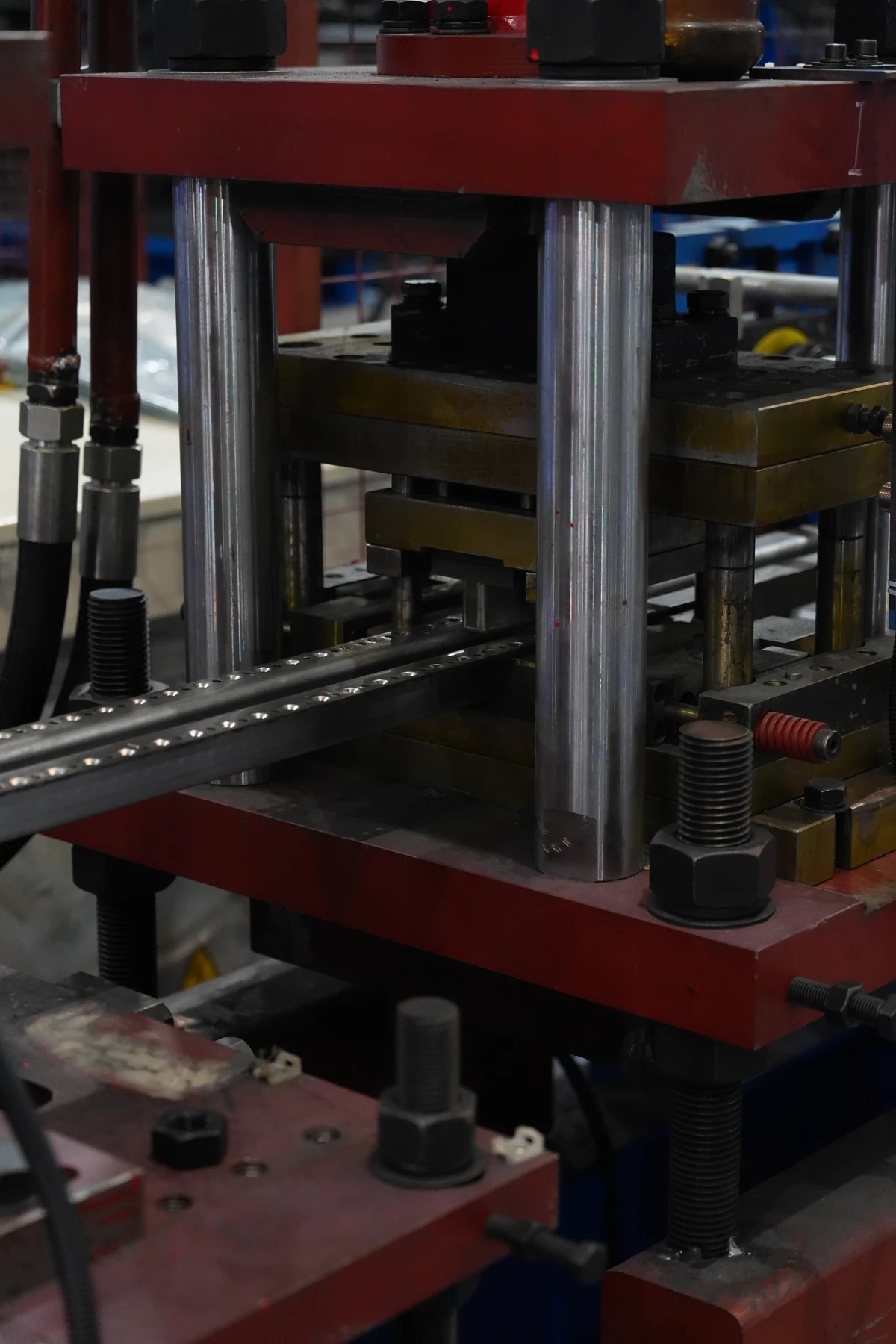
The accompanying site-visit photo shows a press station and a perforated section. It is not a record of this test, a named machine quotation or evidence of which punching sequence was used.
Buyer questions
Does a pre-punch unit guarantee accurate holes after forming? No. The finished part must be measured against the approved drawing, especially around bends and changes in profile geometry.
Is post-punching always better for a hole near a bend? No. It is an option to review, but the finished profile must allow tool access and support. Have the proposed manufacturer show the die arrangement and trial result.
Can one machine cover every stud, track, C and Z hole pattern? Do not infer that from a generic machine label. Compare each approved section, hole layout, tooling set and changeover trial with our factory team.
Get a quote for this machine
Send your profile drawing or a photo of the profile. We reply within 24 hours with a configuration and price.
Commercial terms
- Lead time
- standard machines 30–60 days; automatic and heavy-duty lines 60–120 days (confirmed in the quotation).
- Warranty
- 12 months on the machine, lifetime technical support by video and remote guidance; wear parts excluded.
- Payment
- 30% deposit; 70% before shipment, after you approve the trial-run video.
- Shipping
- FOB Xiamen, China.
Sources, scope and next step
The process-order considerations above are informed by Samco Machinery's published applications guidance and its equipment-integration overview, with Metform's published C/Z pre-punch listing as an example of a supplier configuration. These sources describe their own engineering and products; they do not verify a machine offered by Halcyon. Halcyon Machinery handles specification and supply factory-direct from our Xiamen production base; no tested performance is claimed on this page.
To compare a proposed line, review the punching equipment scope, C/Z configuration questions, stud/track equipment and profile sample acceptance method. Send the drawing and punching layout for a supplier-specific review.
Technical sources for review
- Samco Machinery: roll-former purchase and hole location
- Samco Machinery: front-end piercing and post-punch integration
- Metform: an example of a C/Z pre-punch line
These sources describe general engineering choices and other suppliers' equipment. They do not certify a Halcyon line or a trial outcome.