
By Halcyon Machinery · Technical content review · Published
Direct buyer answer
For a multi-size C-purlin machine, trial the smallest, most frequently ordered and largest approved C sections. Record the coil identity, entered recipe, actual adjustment steps, punch and cut settings, setup scrap and first accepted piece at each size. Measure repeat pieces against each drawing. A catalogue range or a button-operated adjustment claim cannot prove that your three profiles, holes and lengths are covered.
First define the size envelope on your own drawings
Prepare a controlled drawing for each C section with web, flange, lip, steel grade, base-metal thickness, coating, coil width, hole layout and finished lengths. Pick the smallest and largest sections you intend to order, not merely the endpoints in a manufacturer's catalogue. The most frequently ordered section matters because it shows normal production, not only an extreme trial.
our Xiamen production base's named HC-300L C-only reference publishes a web-width range of 75–300 mm, flange 30–80 mm and lip 10–20 mm. It describes size selection by button and a forming speed of 30 m/min without punching and cutting; its page also says the machine stops for punching and cutting. These are our Xiamen production base's reference figures, not a promise that every combination or an offered Halcyon build will pass your drawings. The trial must use the actual proposed tooling and controls.
Record three size runs rather than one demonstration
| Trial run | What to record | What to measure |
|---|---|---|
| Smallest approved C | Coil grade and thickness, drawing revision, entered web/flange/lip settings, tooling and setup scrap. | First and later accepted pieces: section dimensions, cut length, straightness and any required hole locations. |
| Most frequent C | Adjustment steps and time from the last accepted small part to the first accepted normal part; any manual corrections. | Repeat part dimensions and hole positions at the production pattern and cut lengths actually ordered. |
| Largest approved C | New settings, any tool or cutter replacement, coil change, first-off rejects and time to an accepted piece. | Dimensions, cut length, straightness and holes at the upper end of the buyer's approved envelope. |
| Return to normal size | Recipe recall, adjustments and the first accepted piece after returning from the largest size. | Whether the repeated normal-size part still meets the same drawing and tolerances. |
Write the agreed measuring datums and tolerances on the trial record before starting. A time stated without the first accepted piece, rejected setup parts and punching/cutting conditions is not a comparable changeover result. If a different die, cutter or punch is needed, list it in the quotation instead of treating it as included automatically.
Keep size adjustment separate from C-to-Z changeover
Changing among C-section dimensions does not establish Z-section capability. The HC-300L reference is a C-only listing. If the order book includes Z purlins, compare a separately documented automatic C/Z machine and run both C-to-Z and Z-to-C trials. The C/Z changeover test record addresses that different acceptance question.
Similarly, a formed C section is not by itself a structural approval. The project engineer decides its section, material, holes, connections and application. The machine trial establishes whether the proposed equipment makes the specified member consistently under stated conditions.
What should the quotation state?
Request the named machine model, included size and thickness envelope, forming and punch tools, cutter arrangement, coil handling, control recipes, electrical scope, exceptions and accepted output definition. Ask the supplier to attach the three-size trial sheet and labelled sample parts. The C purlin machine page compares fixed C and adjustable C routes; use your drawing package to decide which route to quote.
Questions buyers ask
Does “75–300 mm” mean every C profile in that width range is covered?
No. The full web, flange, lip, thickness, grade, holes and cut lengths must fit the actual tooling and signed scope. Trial your approved combinations.
Does a 30 m/min forming figure predict finished purlins per hour?
No. our Xiamen production base's reference describes 30 m/min without punching and cutting and says the line stops for those operations. Measure accepted parts over a defined trial with your hole pattern and lengths.
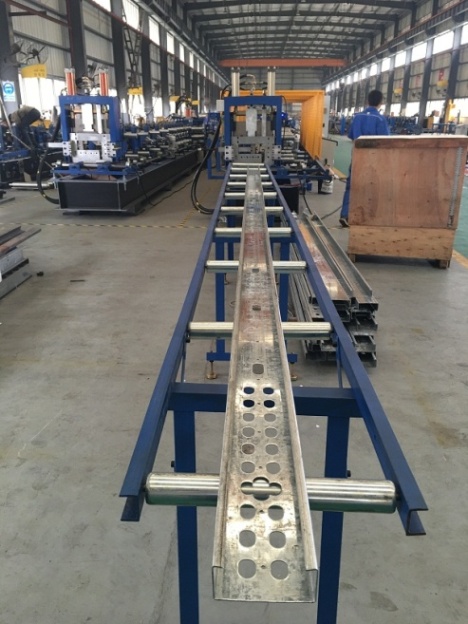
Can this outfeed photograph prove the machine's changeover time?
No. It shows one formed C section at the outfeed. Record settings, setup scrap and the time between accepted pieces during a witnessed trial.
Source and scope: HC-300L published product sheet and sample photograph, reviewed 2 October 2026. The three-size sequence is Halcyon's procurement test framework, not a claim that the reference machine has already passed it. Final capability, tolerance, output and supply scope require the buyer's drawings, a model-specific written offer and measured trial.
Send three C-section drawings for review