
Leg dimensions
Mark each leg independently, including any unequal-leg requirement and the points from which dimensions are taken.
An HAS-10 angle-section roll forming line is identified in our Xiamen production base's product catalogue. Select the offered build from a dimensioned angle drawing and a witnessed sample, not from the model name alone.
Before requesting a proposal, specify both leg lengths, included angle, inside corner radius, steel grade, thickness range, any hole pattern and target output. A roll-formed angle must not be assumed interchangeable with a hot-rolled structural angle: the section, material properties and intended use need separate engineering review.
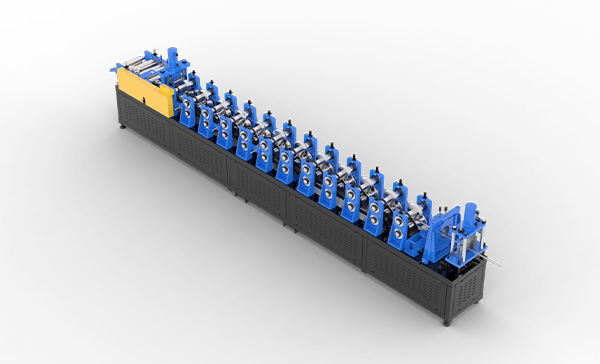
Our Xiamen production base's catalogue rendering, not a photograph or specification of the offered build.
The search term “angle roll forming machine” can describe different production requirements. For a steel angle used in a bracket, support or fabricated assembly, send the complete section drawing for an HAS-10 configuration review. If the requirement is a suspended-ceiling perimeter trim, start with the wall-angle roll forming machine buyer guide; its plain L trim, perforated corner bead and shadow-gap profiles need their own tooling review.
A shared L-shaped outline does not establish a shared material range, roll set, punch tool or cut-off die. Compare both leg lengths, included angle, bend radius, lips or returns, material grade and thickness, hole pattern and finished length. Ask our factory team to mark which drawings are supported by adjustment, which need replaced tooling and which require another line.
For more than one drawing, request a per-section tooling and changeover scope before comparing prices. Agree repeat samples for each proposed section and record the drawing revision, coil identification and setup used. The equipment quotation checklist helps compare included modules and exclusions; no price or capability is inferred from the HAS-10 model name.
Small differences at the bend can determine whether the finished angle fits a bracket, support or assembly.
Mark each leg independently, including any unequal-leg requirement and the points from which dimensions are taken.
State the included angle and inside radius. Ask for measured first-off parts instead of judging the bend from a rendering.
Provide steel grade, thickness, coating and permitted variation. Request a written material envelope for the quoted tooling.
If required, identify hole size, pitch and edge distance on the same controlled drawing; confirm the proposed processing route in writing.
The public production-base page identifies HAS-10 as angle-steel roll forming equipment. It does not establish a verified speed, thickness range, power, punching system or tolerance for a Halcyon quotation.
Source and limit: HAS-10 product listing confirms the model identity; checked 26 September 2026. Other capabilities above are buyer questions, not claims that every HAS-10 build includes them. Reviewed by Halcyon Machinery on 2 October 2026.
Agree the test drawing and material before the factory trial. Record actual values instead of relying on a catalogue image.
If the drawing calls for a U-channel, purlin or another structural shape, review its own tooling and trial rather than assuming the HAS-10 line can make it.
The public model listing does not confirm the punching configuration. Send the hole layout and require the proposal to identify tooling, sequence and sample acceptance.
Do not assume equivalence. Ask the responsible engineer to review section geometry, material properties and the end use before substituting a structural member.
No. Agree a trial or cycle estimate using the actual steel, dimensions, hole density, length and handling scope.
Halcyon will check the drawing and ask our factory team to confirm the suitable build, written scope and sample test plan.