
Long-part capability
The working length supports long flashings, trims and sheet-metal components.
For steel door-frame drawings, compare the complete roll forming and bending routes; verify this bending machine against a physical sample before selecting it.
Our Xiamen production base publishes HFB-6500 as a hydraulic CNC sheet-metal bending and folding machine. Match its proposed tooling, material, bend sequence and trial samples to your part drawing. If you need a conventional press brake, confirm the bending mechanism and tooling with the supplier before treating this model as an equivalent.
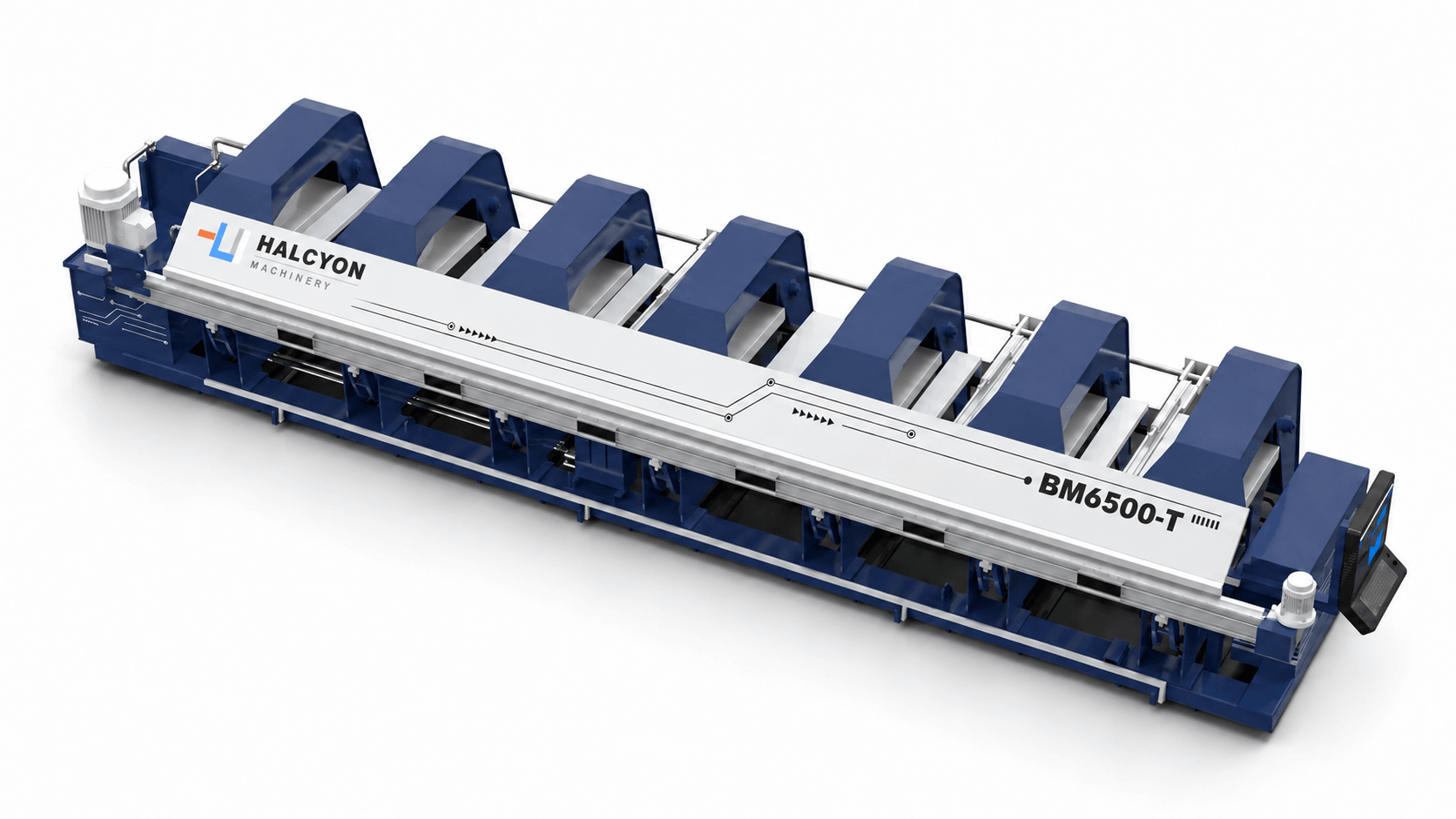
Production-base model rendering, not a timed acceptance trial or proof of the machine offered for your drawing. Ask us for a demonstration video, current build photographs, the signed configuration and a trial plan.
The engineering starts from the part, material, tolerances, operations, production data and required output.
The working length supports long flashings, trims and sheet-metal components.
Servo positioning and stored programs reduce repeated manual measurement.
The published HFB-6500 configuration combines slitting and bending operations.
Tooling and pressure are selected for steel, stainless steel or aluminium.
Values below separate confirmed product information from project-dependent engineering data.
Source and scope: the HFB-6500 reference figures above come from our Xiamen production base's published HFB-6500 model sheet (reviewed 27 September 2026). Its approximately 48 m/min figure is the slitting-unit speed, not finished bent parts per minute. These figures describe that production-base reference model; they are not guaranteed values for a different configuration. Power, tooling, dimensions and production acceptance become binding only when repeated in the signed technical agreement for your project.
The proposal defines every station, interface, production assumption and acceptance checkpoint.
Request the current machine layout, component list, sample part and test plan for the exact quotation.
Options are quoted only when they match the approved production workflow.
Machine length and support arrangement configured to the longest finished part.
Cylinder quantity, tooling and controls matched to material and thickness.
Integrated slitting wheel and positioning system where required.
Stored bending programs and graphical production input.
Front and rear supports for long or flexible parts.
Destination voltage, guarding and applicable electrical requirements are specified in the proposal.
The HFB-6500 production-base reference identifies long sheet-metal flashings, trims and architectural components as applications. Confirm the actual part drawing, tool clearance and bend sequence with a trial of the offered build.
Compare the offered machine against a complete part, not an isolated bend. Use the same drawing revision and material for each proposal, and ask for a continuous demonstration from the flat blank to the finished part. Record any manual repositioning and separate slitting time from folding time.
| Purchase question | Evidence to request for the offered build | How to compare the result |
|---|---|---|
| Will every bend fit the tools? | Numbered bend sequence, tooling drawing and views of the part at each operation, including already formed flanges. | Check clamping, throat and tool clearance through the whole sequence. A maximum working length or angle does not establish clearance for your section. |
| Can the required material be formed? | Trial material grade, thickness, coating and batch identification, tied to the part drawing. | Compare measured angles after release and inspect bend surfaces. Do not apply a published capacity for one material to another grade or coating without a matching trial. |
| Are long parts supported consistently? | Loading, support and removal arrangement shown during the trial; dimensions taken at agreed positions along the finished part. | Review angle and flange variation along the part against the drawing tolerances, including handling and repositioning. |
| What is the usable production rate? | Elapsed time, number of accepted parts, operators, loading, repositioning, removal and inspection included in the record. | Use accepted finished parts over the recorded interval. The published slitting speed is not a finished folded-part production rate. |
| What changes between part families? | A trial changeover between agreed drawings, showing program selection, tooling adjustments and first-part checks. | Compare the complete changeover procedure and any excluded setup time; do not infer automatic compatibility from stored programs alone. |
| What is included in the quotation? | Signed configuration covering tools, supports, slitting if required, guarding, electrical supply, training and explicit exclusions. | Keep the quoted model and revision with the trial record. Separate production-base catalogue references from the equipment and services actually offered. |
Agree measurable acceptance criteria with our factory team before the trial. These are procurement checks, not a statement that any particular configuration has already passed them. Send your finished drawing, flat blank and material specification for a proposal review.
Procurement checklist reviewed 2 October 2026. Published HFB-6500 values remain production-base references; order-specific results require evidence for the proposed build.
For return flanges and restricted tool access, use the folding sequence and part-clearance trial guide to record the complete bend order, support, repositioning and removal of the finished part.
Send the finished part drawing with bend locations, angles, flange lengths and tolerances. Include material grade, thickness, sheet dimensions and the longest finished part.
Do not assume equivalence from the page URL or the word bending. Our Xiamen production base describes a hydraulic CNC sheet-metal bending and folding machine. Request the actual forming mechanism, tooling and a complete bend-sequence demonstration for your drawing before comparing it with a conventional press brake.
Start with the part and production pattern. A bending machine is assessed against the required bend sequence and changeovers; a roll forming line is assessed against a repeated profile, coil-fed workflow and any inline operations. Ask for a sample trial against your own drawing before choosing either route.
Ask for the proposed working length, tooling and bending sequence, material handling, electrical scope and exclusions. Agree the sample material, dimensions to measure and acceptance record for the offered build; do not infer guaranteed output from a model name.
We will review the bend sequence, material and part length before confirming the offered machine scope and a suitable sample trial.