
By Halcyon Machinery · Internal technical editorial review · Published and reviewed
Versão em português: viga de beiral, inclinação e corte
Русская версия: карнизный профиль, уклон и резка
También disponible: guía en español sobre perfiles de alero.
Direct buyer answer
Before buying an eave strut roll forming machine, send a revision-controlled section drawing and its installed orientation. Identify the sloped flange, the direction of the slope, the return lips, the connection holes and the finished ends. Ask the supplier to map the forming and cut tools to every required variant. A C-shaped outline or an eave-strut catalogue name does not establish that an ordinary purlin line can make your section.
Define the installed section before the machine name
An eave strut connects with other parts of the building at the roof edge. The production requirement must describe the actual approved component, rather than relying on the word “eave”, “eaves beam” or “C purlin”. Attach the cross-section, end details and connection drawing together. Use the same part identifiers in the drawing schedule and the quotation so that a similar-looking catalogue section is not substituted for the required part.
Keep the roof pitch and the required flange geometry distinguishable in the drawing. Have the project designer identify the surfaces and the angle definitions to be checked. Do not infer a flange angle from an unlabelled roof-pitch number, a photograph or a drawing printed at a different scale. This guide supplies procurement questions; it does not define a building section or its structural suitability.
Keep slope and handing as separate requirements
Mark the top and bottom flange, the outward-facing side and the installed orientation. If the production schedule includes opposite-handed parts, give each a controlled drawing or a clearly defined variant identifier. Turning a sample around for a photograph does not prove that the line can produce the other variant. The hole layout and the end connection must still match the installed orientation.
For each variant, request a written explanation of the forming tools, setup adjustments and any additional operations required. Distinguish a setup change from a tool replacement and from a separate line. Do not assume that a quoted “adjustable” machine automatically covers every flange slope, lip geometry or combination of material and thickness on your schedule.
Resolve the actual punching and cutting sequence
Ask for a station sequence for the configuration being offered: identify where the strip is guided, where the specified holes are made, where the section is formed and where it is cut. Include any separate operation needed to finish the component. A generic process label is not enough to establish the sequence or the required handling equipment.
Our Xiamen production base's source reviewed for this guide contains a process illustration whose pre-cut wording and downstream cut label need clarification. Halcyon therefore does not treat either as a verified process guarantee. Resolve the order in the written proposal and trial plan. Where a finished-section cut is offered, ask how the tool supports the actual flange and lip geometry, and which section variants use the same die. Where another cutting method is proposed, ask how finished lengths and end details will be checked.
Tie holes and ends to the intended connection
Provide the hole shape, face, datum, orientation and any local forming detail on the approved drawing. A distance written without its reference edge can leave two suppliers quoting different components. Identify the mating connector and fasteners used in the proposed assembly check. If a connection requires a feature beyond a plain hole, identify that operation explicitly instead of assuming that a standard punching module includes it.
Agree how the finished end will be assessed, including any interference with the connector and the required fit. Do not transfer the details of another manufacturer's eaves-beam system into your order simply because the overall outline looks similar. Dimensional conformity and a successful assembly check remain separate from the project's load approval.
Use a variant-by-variant tooling matrix
| Drawing requirement | Supplier response to request | Acceptance record |
|---|---|---|
| Flange slope and installed orientation | Tools and setup for the identified section variant | Labelled samples and agreed angle measurements |
| Opposite-handed part or different lip | Shared tools, replacement tools or additional operation | Separate sample identity for each required variant |
| Hole and end connection | Punch and cut tools, datums and process order | Dimension checks and agreed assembly observations |
| Material and production mix | Supported drawing/material combinations and included handling | Coil identity, setup record and repeat pieces |
Leave unresolved combinations visibly open. A tool matrix is useful only when its entries correspond to the offer and the released drawings; blank cells should not be interpreted as approval.
Plan the trial without inventing tolerances
Agree the measurement method, sample locations and acceptance limits before producing trial pieces. Record the drawing revision, coil identity, material, measured thickness, tool set and machine setup. Retain first-off and later pieces from the agreed sequence. Check the released flange angles and dimensions, hole positions, finished lengths, end condition and the intended connection using the approved references.
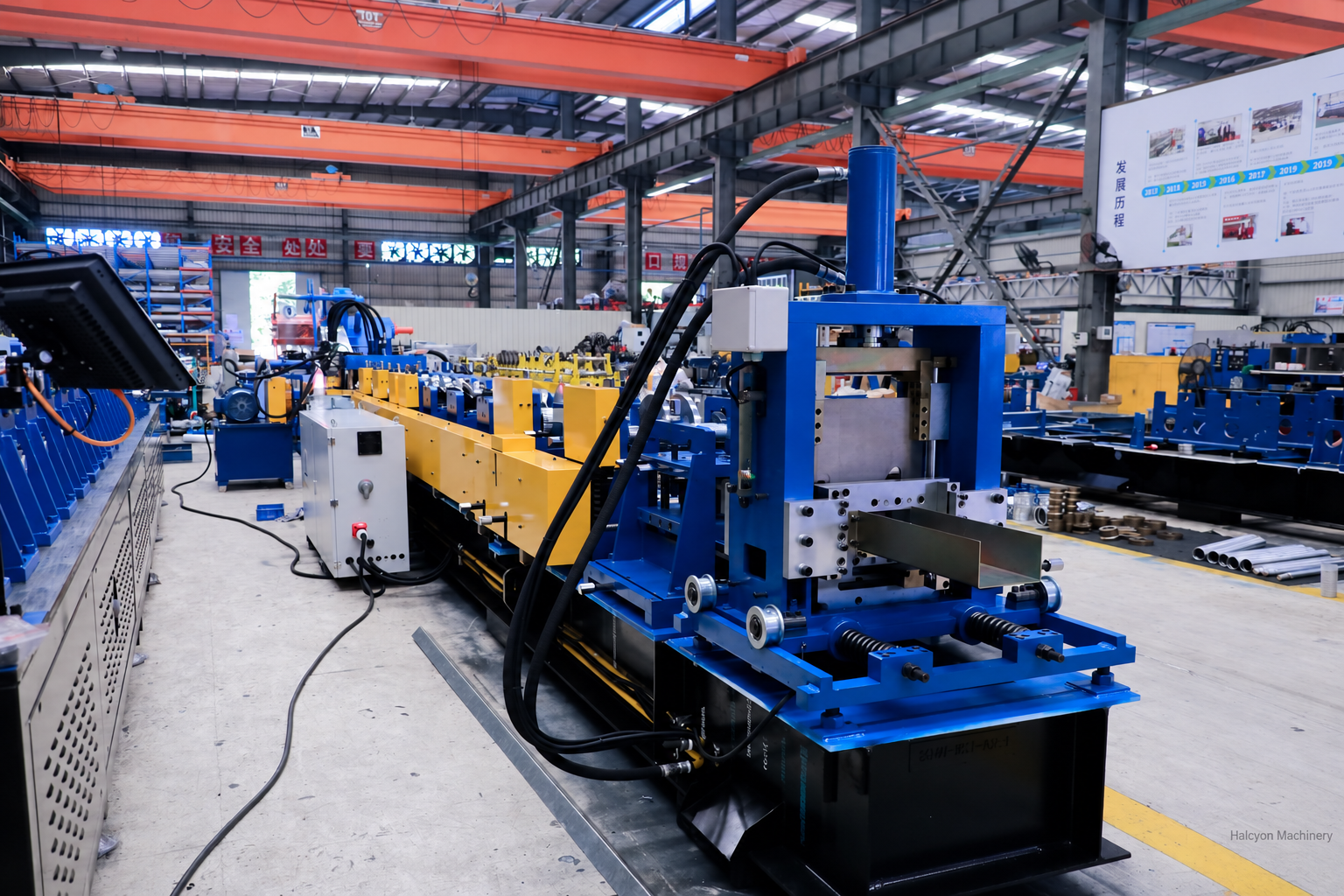
When a setup is corrected, retain the deviation and identify the new samples used for the repeat check. Do not report a general pass from only the best piece. Capacity, changeover time and accepted output require their own agreed observations. The equipment photograph above and this checklist do not supply those results.
Open the printable eave-strut variant review record. The drawing, tooling, tolerance and result fields are intentionally blank. The record is a procurement aid, not a certificate or a completed factory acceptance report.
Questions before comparing quotations
Can a normal C/Z purlin machine automatically make an eave strut?
No automatic equivalence is established. The supplier must review the sloped-flange section, installed orientation, holes and ends, and identify the forming, punching and cutting tools for that drawing.
Does a catalogue drawing prove the available roof-pitch range?
No. Accepted section variants and their setup or tool changes must be identified in the proposal. Measured trial pieces are needed for the agreed acceptance checks.
Can opposite-handed parts be treated as the same trial sample?
Not without an agreed drawing and acceptance definition. Identify each required variant and its orientation, hole datums and end connection, then retain the corresponding sample records.
Does a machine trial approve the roof or building loads?
No. A machine trial concerns the agreed manufacturing checks. Structural adequacy, connections, roof loads and the completed building require separate project engineering evidence.
Send a drawing schedule for equipment review
Halcyon Machinery provides cold-formed steel roll forming equipment configured to customer drawings and production requirements. Send the eave-section variants, installed orientation, material grade and thickness range, hole and cut layout, finished lengths and production mix. Request a written response identifying included tools, handling modules, setup steps, exclusions and trial evidence for each variant.
Our purlin equipment selection guide explains general line choices, but does not establish eave-section compatibility. The quotation checklist helps define the scope being compared. Submit the drawing for review rather than selecting an existing model solely because its catalogue says C/Z.
Send eave-section drawings and production requirementsSource and review scope
Our Xiamen production base's eave-strut equipment page, consulted on 5 October 2026, supplies the photograph and published section/process context. Its generic C/Z fields are not treated as proof of a Z-profile capability or a current Halcyon quotation. No catalogue speed, gauge range, certification or universal pitch capability is promised here. The drawing review matrix and trial record are Halcyon editorial recommendations; they do not describe a customer's purchase or a witnessed trial. No matching public Halcyon video of this specific eave-section trial was verified, so none is embedded.