
Decoiler / Uncoiler and Stacker Equipment
Specify coil handling and finished-part stacking from coil mass, section drawing, line controls, floor layout and handling trial requirements.
Direct buyer answer
Choose a decoiler or stacker from the actual coil, product and factory interfaces. A generic accessory image or catalogue load figure cannot prove compatibility with an existing roll forming line. Halcyon can arrange a factory review after the buyer supplies the coil and finished-part data, layout and controls information.
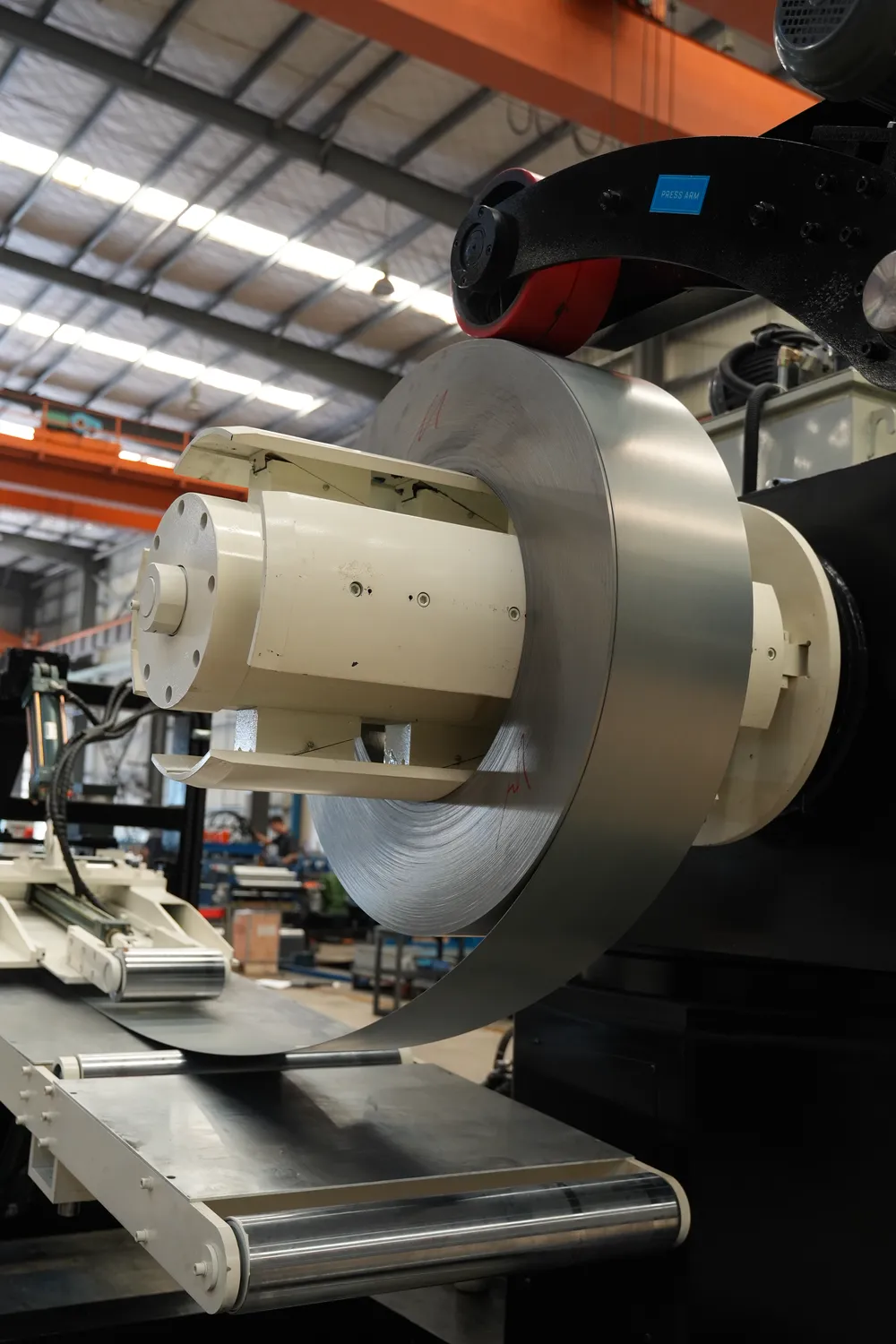
Decoiler or uncoiler: check the production pay-off mode
A decoiler, also called an uncoiler, releases strip from a coil into the next process. The name alone does not specify the drive, loading equipment or control arrangement. A stacker handles finished parts at the other end of the line.
| Arrangement to identify | Production distinction | Ask the quoted supplier to demonstrate |
|---|---|---|
| Drag-brake pay-off | The downstream equipment pulls the strip; the decoiler brake resists coil rotation. | Feeding and stop/restart with the agreed coil and downstream machine. |
| Motor-assisted threading or rewind | A jog motor can help setup while normal production still uses drag-brake pay-off. | Which operations use the motor and which rely on downstream pulling. |
| Powered loop-controlled pay-off | The drive releases strip into a slack loop; loop control regulates pay-off. | The proposed loop, sensors, drive response and interfaces during the trial. |
Describe mandrel expansion separately from production drive. Ask what a label such as “hydraulic decoiler” means in the offer: coil gripping, coil-car movement, another function or the drive itself. Confirm each mechanism in the component schedule; do not select it from the label alone.
Technical references: ARKU uses decoiler and uncoiler for the coil-release component; Custom Rollform Products distinguishes drag-brake, motor-assisted and powered-loop arrangements. These references explain terminology, not a Halcyon supply specification. The offered configuration and trial must identify the actual arrangement.
Prepare the coil-loading trial record and send coil data and the existing-line layout for a configuration review.
Decoiler checks
Provide coil mass and inner/outer diameter, strip width, loading method, feed direction, floor space, electrical supply and required safety arrangement. Ask the proposed supplier to document mandrel, brake, drive and coil-car scope as applicable. A nameplate or rated capacity must belong to the exact offered machine, not to a generic range.
What should a decoiler machine quotation include?
Compare offers for the same coil envelope, pay-off arrangement, loading method and host-line interfaces. A base-machine price and a complete installed handling package describe different scopes. Ask each supplier to mark every item as included, optional, excluded or awaiting confirmation.
| Quotation item | Written basis to compare |
|---|---|
| Coil and mandrel | Offered model, rated coil mass, bore range, outer diameter, strip width, expansion and support arrangement |
| Production pay-off | Brake or powered drive, threading/rewind functions, loop controls and agreed stop/restart sequence |
| Loading and layout | Loading equipment, any coil car, required access and floor layout; identify separately supplied lifting equipment |
| Host-line integration | Control signals, electrical supply, protection arrangements, interface responsibilities and integration work |
| Trial and service | Trial material and measurement scope, installation, training, manuals, spare parts and written warranty responsibilities |
| Commercial costs | Currency, quote validity, named delivery place, packing, freight and applicable import costs requiring separate confirmation |
For a decoiler with straightener or feeder, identify those additional units and their interfaces in the offer. A coil-release unit alone does not establish a complete leveling and feeding package. Compare the same agreed coil and production sequence during the trial.
Download the blank decoiler quotation comparison, then send coil data and your line layout. Keep unknown costs pending and request a revised inclusion list before comparing totals.
Stacker checks
Provide the longest and shortest product, section drawing, cut cycle, target output, surface-finish sensitivity, bundle plan and discharge route. Check that the stacker can receive first-off and later parts without jams or unacceptable scratching, and that guards and access are compatible with the host line.
Integration evidence
- Record the host-machine model and available control and safety interfaces.
- Approve a floor layout showing coil loading, service clearances and bundle removal.
- Use identified trial material and finished parts to check feeding, stacking and the stop/restart sequence.
- Retain the proposed equipment drawing, component list and agreed acceptance record.
Buyer questions
Can a new stacker be added to any existing line?
Not automatically. Controls, safety, product path, available floor space and cut sequence require an integration review.
Is a published decoiler load range enough to select a model?
No. Coil dimensions, handling method, dynamics and the offered machine's documented rating all matter.
Browse auxiliary equipment and the cut-off review, then send your line layout and coil data.
Source and limits: Halcyon Machinery buyer-review framework, updated 3 October 2026. Halcyon supplies factory-direct from our Xiamen production base; this page does not claim a rated model or a verified retrofit.
Request an integration reviewRecord the coil-loading trial
Before approving a proposed uncoiler, match the identified coil and loading method to the quoted configuration. Use the coil-loading trial record and blank worksheet to separate visible setup from measured finished-part evidence.