
By Halcyon Machinery · Technical content review · Published
Direct buyer answer
Start with the engineer-approved floor deck section, not a machine catalogue label. An open-rib deck and a re-entrant rib have different section geometry, so request a named tooling and changeover proposal for each drawing. Measure first-off and repeat trial sheets from the actual proposed line. The trial can prove formed dimensions and fit; it cannot by itself certify composite slab strength.
Define the profile before comparing machines
“Open-rib” commonly describes a deck with accessible trapezoidal ribs. “Re-entrant” describes a rib with a narrowed opening. Suppliers may also call the latter “closed,” but closed can mean a different cellular deck assembled from more than one sheet. Do not choose tooling from these labels alone. Send a dimensioned section with rib depth, pitch, flange and side-lap geometry, embossment pattern where specified, material grade, coating, thickness range, coil width and installed cover width.
The Steel Deck Institute's composite and non-composite standards classify deck by its structural role in a designed slab, not simply by whether a rib looks open or closed. Its Floor Deck Design Manual separates deck manufacturing from the licensed designer's structural responsibility. Obtain the project-approved deck system and section before ordering production equipment.
Compare the equipment scope, not a generic speed
| Buyer decision | Open-rib drawing | Re-entrant or other closed drawing |
|---|---|---|
| Tooling | Identify the roll set for the approved trapezoidal section. | Identify the roll set, forming sequence and any secondary operation for the exact narrowed rib or cellular assembly. |
| Material | Trial the specified grade, coating and thickness limits. | Use the same material evidence; do not infer the second profile from a trial of the first. |
| Optional operations | List embossing, punching, cutting and stacking only where required. | Confirm embossing or joining modules in the written scope; a profile photo does not prove their inclusion. |
| Accepted output | Measure rib, side lap and assembled cover width on identified sheets. | Measure the narrowed opening or assembled cell, side fit and cover width at approved datums. |
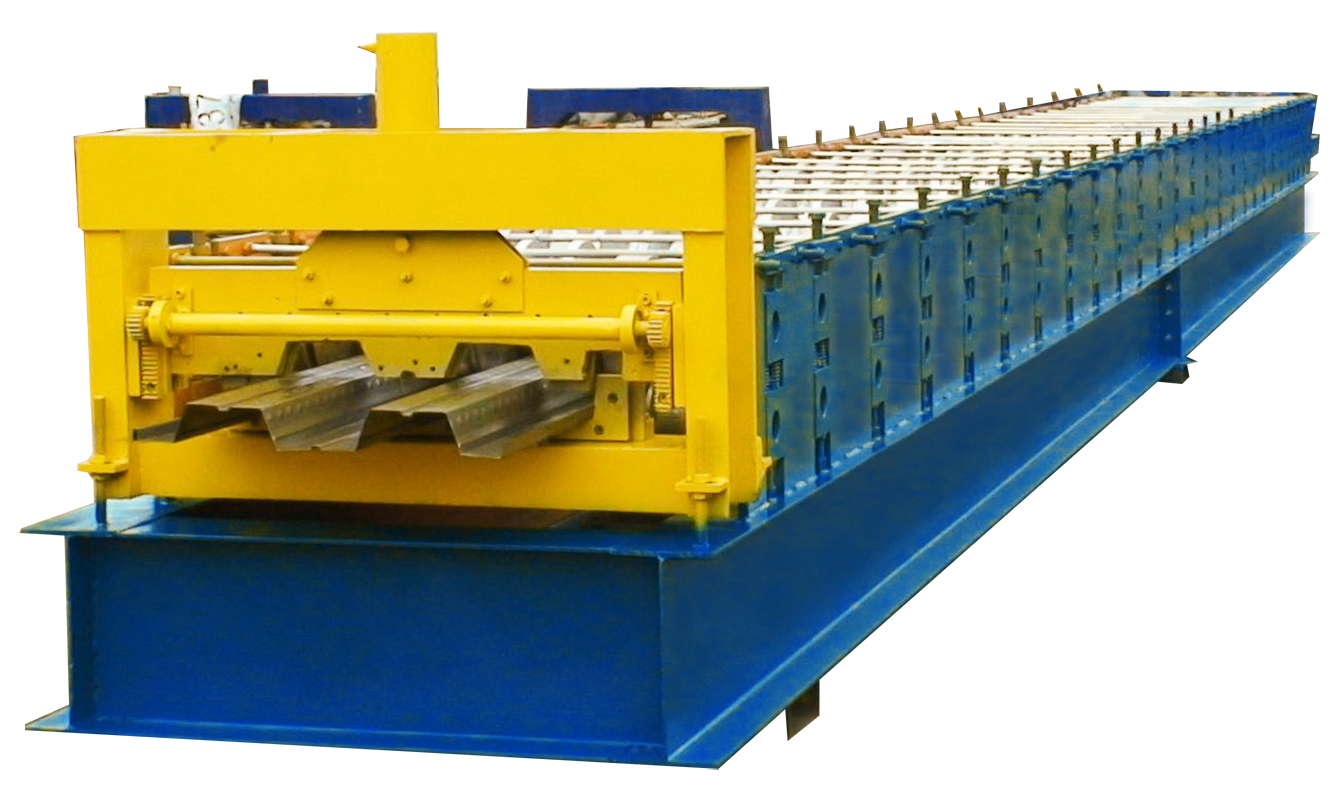
our Xiamen production base's named YX floor-deck example publishes one profile width and one equipment configuration. Those figures are a model reference, not proof that the same rolls cover an open-rib and a re-entrant drawing or that either is included in a Halcyon quotation.
Make a two-profile trial requirement explicit
If your production plan truly needs both profiles, ask whether the supplier proposes separate lines, a documented roll-set change or another arrangement. Put the required changeover parts, time method and acceptance criteria in the quotation. For each section, mark the drawing revision and coil identity on the first accepted sheet and later samples; record measured rib geometry, cover width, cut length, side fit and any embossing or punching. Keep rejected pieces and adjustment notes. Our floor-deck trial-sample checklist covers the measurement record in detail.
Keep structural approval separate from machine acceptance
Neither an open rib nor an embossed re-entrant rib makes a whole floor system compliant on its own. The engineer of record must check the relevant slab design, connection, support, construction loading, fire and local-code requirements. A machine trial answers whether the proposed equipment makes the specified sheet repeatably; it does not replace that engineering review.
Questions buyers ask
Can one set of floor deck rolls make both open-rib and re-entrant profiles?
Do not assume so. Ask the supplier to identify the tooling and changeover scope for each approved drawing, and require separate measured trial sheets.
Does a re-entrant rib by itself prove composite slab capacity?
No. The formed geometry and any embossing can be checked on trial sheets; composite action and load capacity need the project engineer's approved system evidence.
What does 'closed deck' mean in a machine quotation?
The term can refer to a re-entrant rib or a cellular deck made from joined sheets. Require a dimensioned section and named production route before comparing quotations.
Send the section, not just a deck name
Send both approved drawings if you need two deck profiles, along with material, thickness, required options and target accepted output. We can review the ribbed floor-deck machine family with our factory team and identify what must be demonstrated on the proposed equipment. For a narrow steel floor framing member with service holes rather than a ribbed deck sheet, see the separate HLG-300 reference.
Sources and review: Steel Deck Institute standards and Floor Deck Design Manual; our Xiamen production base's official floor-deck and YX model pages, checked 2 October 2026. This article is a buyer's equipment-scope guide, not a load table, engineering approval or promise that one machine makes multiple deck sections.
Have an approved floor-deck drawing?
Send the section and material schedule so the tooling, optional stations and trial evidence can be discussed for your actual profile.
Request configuration review