
By Halcyon Machinery · Internal technical content review · Published and reviewed
Direct buyer answer
Approve the channel section and the hardware together before buying the forming line. A nominal channel width is insufficient to prove that a specified nut can enter, turn, seat and work with the intended bracket. Send the supplier the approved channel drawing, the specified nut and connector identification, material and finish requirements, and the agreed trial-assembly method. The supplier should explain how the proposed forming tools make the required return lips; acceptance must relate to identified trial pieces.
Separate dimensional checks from an assembly check
Measure the features defined by the approved section drawing, including the opening, return lips and their relationship to the web. Use the agreed datums and measurement method. A successful hand fit on one short sample does not replace these measurements or establish repeatability along production lengths. Record which piece and location each measurement refers to.
Use the actual specified hardware
Identify the nut, bolt, bracket and any washer or other specified part by the approved assembly documents. Compare the hardware instructions with the intended channel section and material. Do not replace the specified component with another item simply because it fits more easily. Record insertion, positioning and seating observations under the agreed procedure. Installation torque and fastening limits come from the approved hardware and project instructions, not from a roll-former brochure.
Retain first-off and repeat pieces
Identify the trial coil, drawing revision, tools and setup. Retain first-off and later pieces from the agreed production sequence, including the required finished lengths and slot pattern. Check whether the hardware can be fitted at the specified locations. Where an adjustment changes the formed lip geometry, repeat the dimensional and assembly checks on newly identified samples. Keep deviations and rejected samples in the record rather than documenting only the best piece.
Keep fit separate from load approval
Trial assembly answers a fit question. It does not establish pull-out resistance, slip resistance, structural load capacity, corrosion life or a certified support system. Those claims require the relevant engineering evidence for the actual channel, material, hardware and installation. A third-party system catalogue cannot be transferred to a differently produced section or to a Halcyon equipment quotation.
Compare the equipment quotations
Include the section revision, material and coating, hardware identification, hole schedule, cut lengths, production mix and required acceptance records in the request. Ask whether variant-specific rolls, punch tools or cutoff tools are included and how the offered build will be trialled. Compare offers against that same scope. For the HSM-41 model reference, confirm each requested section and material combination in the written tooling matrix; do not assume all catalogue heights or proprietary hardware systems are covered.
Use three separate approval decisions
| Decision | Evidence | What it cannot prove |
|---|---|---|
| Drawing conformity | Identified sample measurements against the agreed drawing and tolerance rules | That the specified nut and bracket can be assembled correctly |
| Assembly fit | Specified parts, their instructions and observations on identified samples | Rated loads, pull-out resistance or long-term durability |
| Engineering approval | Applicable engineering evidence for the actual channel, hardware, material and installation | That a different machine setup will reproduce the same part |
Do not write one overall “PASS” when a required decision remains open. If the measured section conforms but the nut cannot seat under the agreed assembly procedure, keep that deviation open and investigate both the part definition and the supplied components before changing the tooling.
Prepare a usable record before the trial
Open the printable strut channel trial assembly worksheet. It leaves the drawing, component IDs, acceptance rules and results blank for the actual order. The worksheet is an evidence-organising aid, not a completed test report or certification. Agree who records deviations and who can approve a re-test before the supplier produces samples.
Questions buyers ask
Does a nominal 41 mm channel width prove that a nut fits?
No. The approved section and specified hardware must be reviewed together. The opening, return lips and other drawing features matter; a nominal family size alone is insufficient.
Can a workshop photograph establish channel-nut compatibility?
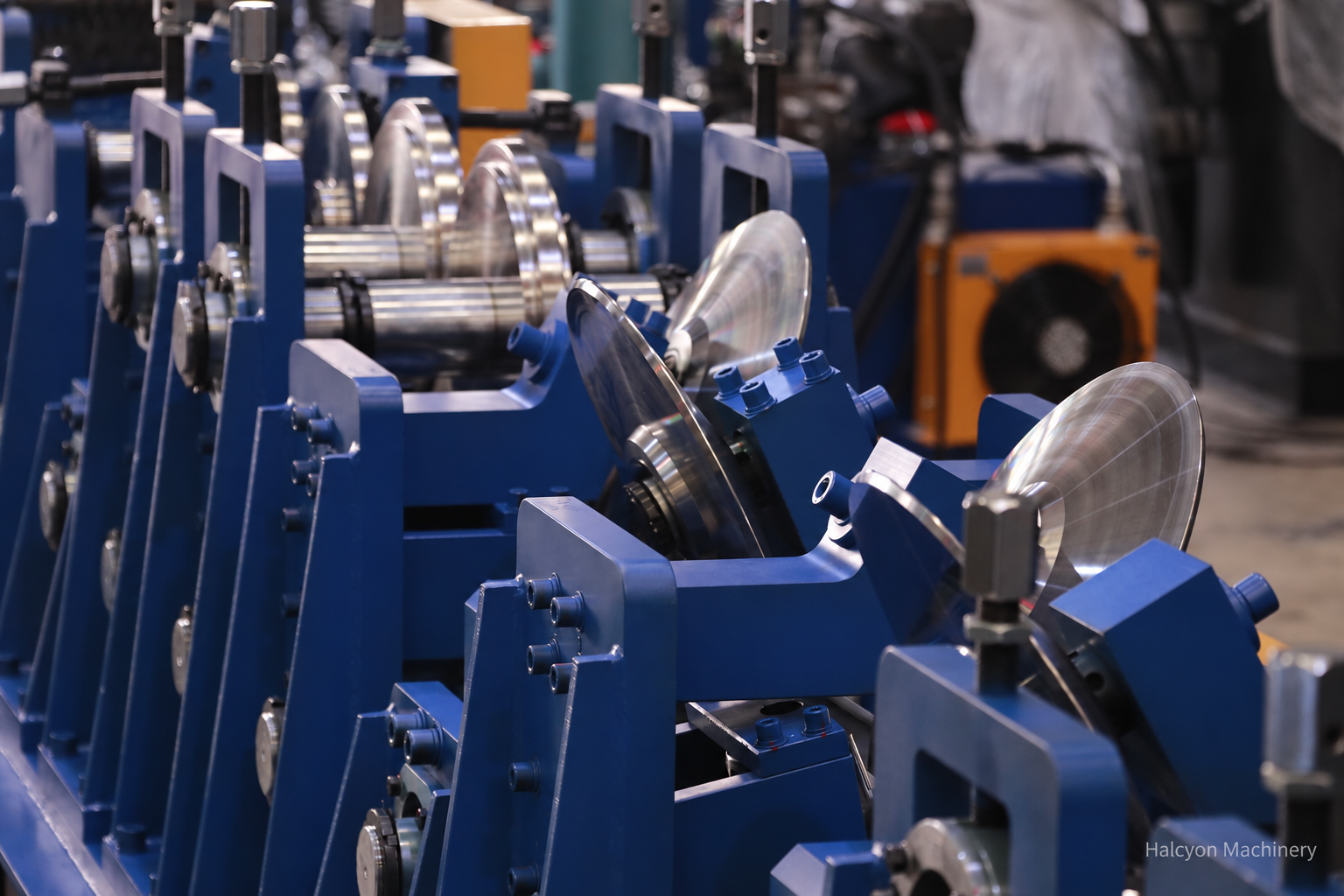
No. The forming equipment photograph provides machine context. Compatibility needs the specified channel and hardware, identified samples and the agreed assembly procedure.
What if the nut fits one sample but not later pieces?
Record the affected sample IDs, measurement locations and machine setup. Investigate the differences and repeat the agreed dimensional and assembly checks after any adjustment; do not select only the best-fitting piece.
Does a successful trial assembly establish the support-system load rating?
No. Fit and load approval are separate. Load claims require applicable engineering evidence for the actual channel, hardware, material and installation.
Send the parts that your production line must make
Halcyon Machinery provides cold-formed steel roll forming equipment configured around customer drawings and production requirements. Send your channel drawing revision, steel grade, thickness range, finish, slot layout, cut lengths, target output and the specified hardware identification. Include the assembly instructions and acceptance-record requirements when requesting an order-specific review.
Compare the HSM-41 strut channel equipment reference with your actual section and tooling requirements. For the wider line trial, use the solar mounting equipment acceptance checklist. This guide addresses the additional hardware-fit decision rather than replacing that production-line review.
Request a drawing and equipment reviewSources and scope
HSM-41 equipment page supplies the equipment photograph and model context. Unistrut’s official brand description explains its channel-and-nut fastening concept. Neither source proves that a Halcyon quotation reproduces a proprietary support system or its ratings. The buyer checklist and worksheet are Halcyon editorial recommendations; no witnessed customer test or hardware endorsement is claimed. Sources reviewed 5 October 2026. No matched public Halcyon video demonstrating this specific assembly was verified, so none is embedded.