
By Halcyon Machinery · Internal technical editorial review · Published and reviewed
Can a step-tile machine cut every ordered sheet length?
Do not assume that a cut-to-length glazed tile roll forming machine can produce every requested length with the same first and last tile-step geometry. Ask the supplier to show how the proposed pressing and cutting sequence handles each order length, step pitch and end allowance. Approve both the overall length and the position of the pattern relative to each cut edge on actual trial sheets.
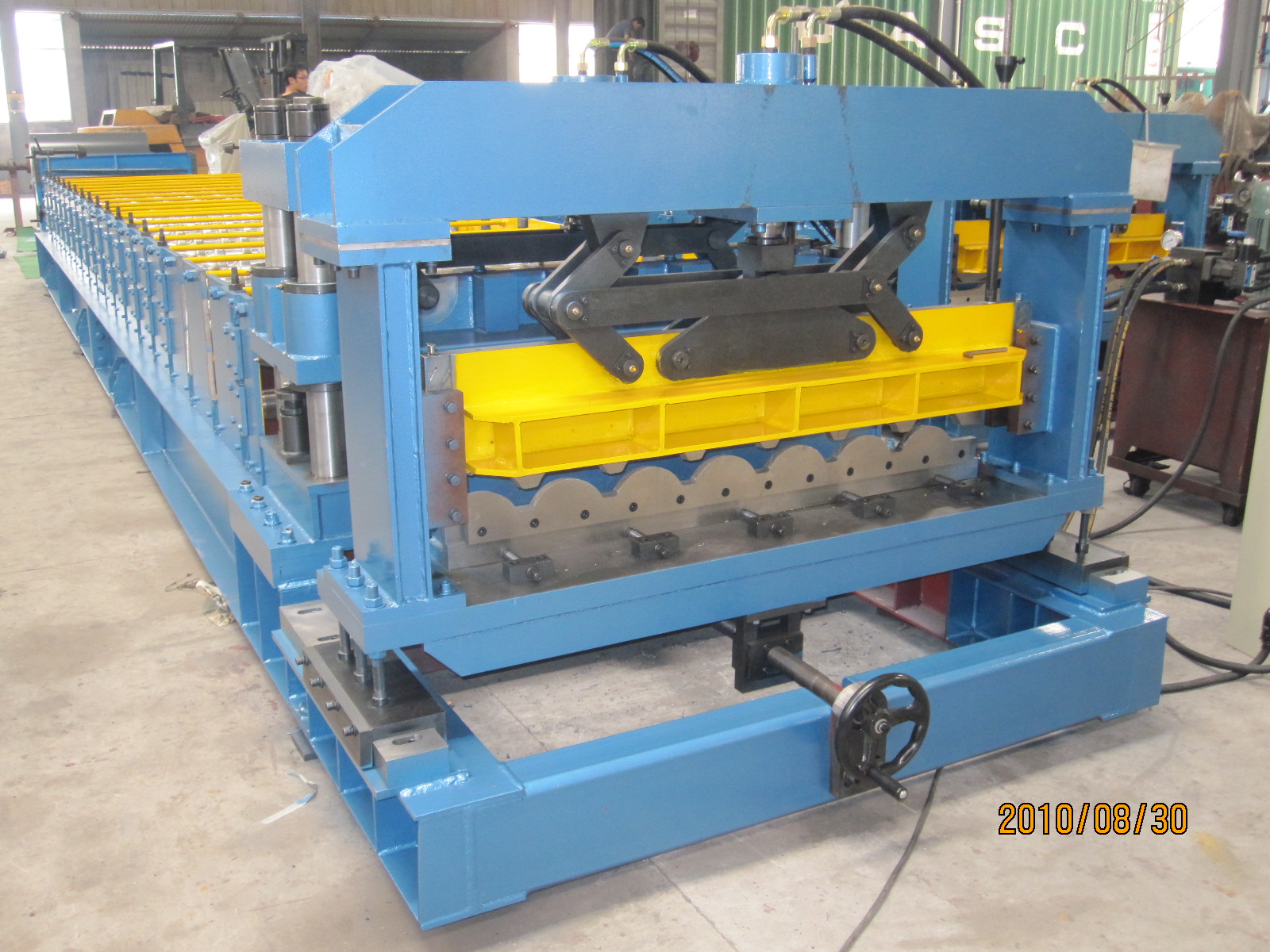
Overall length and pattern position are different checks
A stepped metal roof sheet has longitudinal ribs and a repeating tile-like pattern along its length. A tape measure showing the correct overall length does not establish where the first step starts, where the last complete repeat finishes, or whether the end intended for an overlap has the required shape. Buyers should provide an end detail as well as the cross-section drawing when requesting a glazed tile roll forming machine.
Define the measurement direction and datums on a controlled drawing. Identify the distance from the leading cut edge to a specified point on the first step, the repeat pitch between equivalent points, and the distance from the last specified point to the trailing cut edge. State whether dimensions refer to a horizontal projection, a developed surface or another drawing definition. Mixing these measurements can make an apparently correct sample fail the agreed end detail.
Why a change of order length needs its own review
Changing the requested overall length while keeping the same repeat pitch may change the amount of material left beyond a complete repeat. The acceptable result depends on the approved roof-sheet geometry and on how the proposed line positions the press and cut operations. Some required lengths may need a different end allowance or another approved production arrangement. This guide does not establish that any particular machine can make those changes.
There is no universal rule in this guide that every length must be an exact multiple of the tile pitch. Equally, an encoder or a touch-screen length entry does not prove that every length is compatible with the desired ends. Ask the supplier to identify permissible combinations, restrictions and any additional finishing operations in writing. Have the project designer resolve changes to the roof-sheet end detail before accepting a manufacturing proposal.
Ask for the offered pressing and cutting sequence
Our Xiamen production base's equipment description identifies roll forming, pressing, post-cutting and encoder length measurement. That supports treating step pressing and sheet cutting as separate purchasing checks. It does not establish the cut-to-step phase adjustment, the available end allowances or an arbitrary-length capability for your order.
Request a sequence drawing or a documented demonstration of the proposed configuration. Ask which drawing features are fixed by the tooling, which can be selected in an approved recipe, and which require a tool or configuration change. Identify any separately supplied trimming equipment. These are questions for a trained supplier demonstration, not instructions to adjust a live machine or bypass its guarding.
Use an order matrix before agreeing the quotation
List actual short, intermediate and long sheet orders, not just the longest panel. Include order lengths with different end allowances where your approved drawings require them. Keep the steel grade, thickness and coating identifiable, because a successful demonstration on another material does not validate the requested combination.
| Requirement to record | Question for the proposed line |
|---|---|
| Drawing and part revision | Which exact sheet and end details are being quoted? |
| Repeat pitch and reference point | What equivalent step points define the measurement? |
| First and last end allowances | Can both ends match the approved detail at this ordered length? |
| Permissible order lengths | Which combinations need a changed recipe, tooling or separate finishing? |
| Transition between orders | How are first-off sheets, remaining material and rejects identified? |
| Material and coating | Which trial coil represents the requested production specification? |
Open the blank step-tile length and end-allowance record. It contains no tolerances, passed measurements or machine ratings. Agree each acceptance limit and measurement method before the trial, and retain the identified sample with its drawing revision.
Trial consecutive sheets and a change of length
Ask for consecutive identified sheets at an agreed order length, followed by a change to another length in the matrix. Inspect the first-off sheet after that change separately from later sheets. Record overall length, first-step offset, repeat spacing, trailing allowance, cut-edge condition and visible coating marks using the agreed method. A selected photograph of one successful sheet cannot establish repeatability across an order change.
Place adjacent trial sheets together in the approved overlap direction to check the intended pattern relationship and end detail. This is a manufacturing-fit review, not a roof weather test. Effective cover, fixings, drainage, roof loads and compliance with project requirements need their own design or test evidence. For related joining questions, see the roof-sheet cover and side-lap guide.
Keep usable output separate from forming speed
A purchasing trial should count accepted sheets after the pressing, cutting and handling cycle. Identify setup time, first-off rejection, any additional trimming and order-change losses separately. A continuous roll-forming speed cannot establish accepted stepped-sheet output for a mixed length schedule. Send the order matrix with your target output so the supplier can propose a meaningful timed trial rather than a generic speed claim.
What to send Halcyon
Halcyon Machinery provides cold-formed steel equipment configured to customer drawings and production requirements. Send the section and end-detail drawings, repeat pitch, ordered lengths and quantities, steel grade, thickness range, coating and required inspection limits. We can use these requirements to discuss the proposed configuration and the documents and trial evidence needed before purchase. Request a drawing-based proposal or compare the wider roof and wall equipment range.
Buyer questions
Does cut-to-length mean any length with identical tile ends?
No. The proposed line must demonstrate the required overall length and the pattern position relative to both cut edges. Permissible lengths and any changed end allowances or finishing operations must be stated for the approved drawing.
Must every stepped sheet be an exact multiple of its pitch?
That is not a universal rule. The approved end details and the offered pressing and cutting sequence determine the acceptable length combinations. Ask for a written order matrix and representative trial sheets.
Does a joined sample prove that the roof is waterproof?
No. Joined samples can support a manufacturing-fit check. Weather tightness, fixing requirements, loads and project compliance require separate roof-system design or test evidence.
Source and scope
Equipment-process reference: our Xiamen production base — glazed tile roll forming machine, reviewed 5 October 2026. The order matrix and inspection questions are Halcyon's procurement guidance. No buyer-specific cutting capability, productivity result, certification or roof-system performance is established here. The historical photograph illustrates the equipment arrangement.